
K-12 Education Meaning: What It Is and How Quebec’s System Works
K-12 education refers to the public school system spanning kindergarten through grade 12, covering the years from roughly age five to 17 or 18. The term is common across North America, but Quebec’s Quebec education system follows its own path: students complete kindergarten through secondary 5 (equivalent to grade 11 elsewhere), then typically move to CEGEP (Collège d’enseignement général et professionnel) before university, a structure unique in Canada.
Understanding how Quebec’s K-12 system works matters for newcomers choosing schools, parents planning their child’s education pathway, and anyone comparing provincial systems. The province divides schooling into preschool (maternelle), elementary (primaire, grades 1 to 6), and secondary (secondaire, grades 7 to 11). Public schools operate in French or English depending on eligibility, and the curriculum prepares students for either CEGEP or the workforce.
This guide defines K-12 in plain terms, walks through Quebec’s specific school structure and language rules, explains the types of schools available, and provides clear steps for enrollment and pathway planning. Whether you’re new to the province or simply need a refresher on how the system differs from other regions, you’ll find the practical details you need to make informed decisions for your family.
What K-12 Means in Quebec
K-12 education refers to the full span of schooling from kindergarten through grade 12, covering roughly ages 5 to 17. The term originated in the United States and is used widely across North America to describe the years of compulsory and standard public education before college or university.
In Quebec, the K-12 framework works slightly differently than in other provinces. Students progress from kindergarten through elementary school (primaire) and then move into secondary school (secondaire), which runs from Secondary I through Secondary V, equivalent to grades 7 through 11 in other systems. This means Quebec’s “grade 12” equivalent is actually Secondary V, typically completed around age 16 or 17.
- K-12
- The full span of schooling from kindergarten through grade 12, covering ages 5 to 17 in most North American systems.
- Elementary (Primaire)
- Kindergarten through grade 6 in Quebec, typically ages 5 to 12, where students learn foundational literacy, numeracy, and social skills.
- Secondary (Secondaire)
- Grades 7 through 11 in Quebec (Secondary I to V), usually ages 12 to 17, culminating in a Secondary School Diploma (DES).
- CEGEP
- A two- or three-year post-secondary college unique to Quebec, required before university or leading to technical diplomas, bridging secondary school and university.
After Secondary V, Quebec students enter CEGEP (collège d’enseignement général et professionnel) rather than a twelfth grade. CEGEP functions as a bridge between high school and university or as a pathway to technical careers, making Quebec’s education timeline distinct. For parents and newcomers, understanding this structure is essential when planning school progression and post-secondary options.
How Quebec’s K-12 System Works
Elementary Level (Primaire)
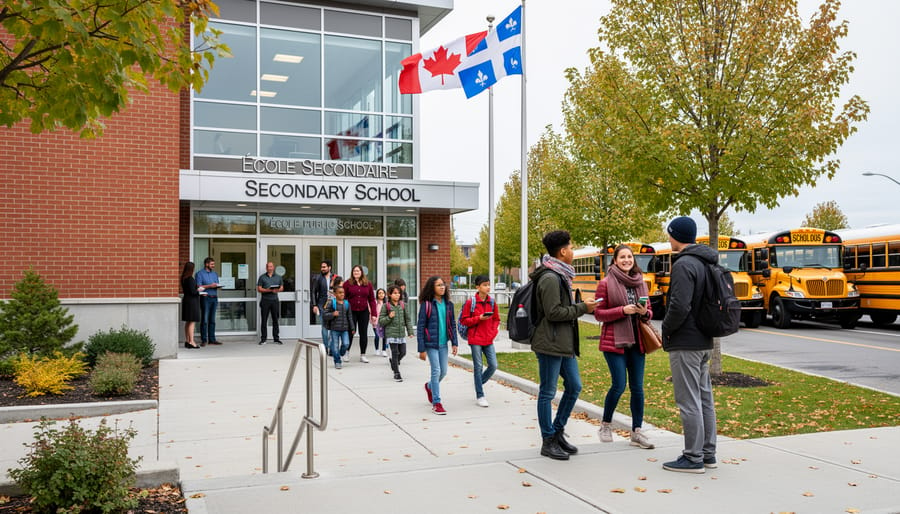
Elementary school in Quebec, called “primaire,” covers kindergarten through grade 6 and serves children roughly ages 5 to 12. Kindergarten (maternelle) is a full-day program for five-year-olds and has been compulsory since 2023. Parents must enroll their child in kindergarten the year the child turns five by September 30.
Students progress through six elementary grades, focusing on foundational skills in French (or English in eligible schools), mathematics, science, social studies, arts, and physical education. The Ministry sets curriculum standards, but teachers have flexibility in delivery. Classes typically stay with the same homeroom teacher for the full year.
School assignment is based on your home address. Each school service centre divides its territory into catchment zones, and your child automatically qualifies for the neighbourhood elementary school. Parents receive enrollment information by mail in late winter or early spring for the following September. Private schools require separate applications, often with deadlines in January or February.
Secondary Level (Secondaire)
Secondary school in Quebec runs from Secondary I through Secondary V (roughly grades 7-11, ages 12-17) and culminates in the Secondary School Diploma (Diplôme d’études secondaires, or DES). Students follow a provincial curriculum that includes French, English, mathematics, science, history, and physical education, with some choice in electives by Secondary IV.
Around Secondary III, students begin choosing between academic and vocational pathways. The academic stream prepares students for CEGEP as a bridge to university, while the vocational stream (diplôme d’études professionnelles, or DEP) leads to skilled trades and direct workforce entry. Both require completion of core subjects and passing Ministry exams.
Most students finish Secondary V at age 16 or 17 and then move to CEGEP for two years of pre-university or three years of technical training. Compulsory schooling ends at 16, but the vast majority continue to CEGEP, which is unique to Quebec and effectively extends the K-12 pathway by two years before university.
School Boards and Language
Quebec’s K-12 system is managed through school service centres (centres de services scolaires) that operate in French, and a smaller number of English school boards serving anglophone communities. The language of instruction is determined by Bill 101, Quebec’s Charter of the French Language, which requires most children to attend French schools.
To access English-language public education, families must hold a Certificate of Eligibility. This applies if a parent received their elementary education in English in Canada, if a child’s sibling is already enrolled in English school, or if the child qualifies under specific transition rules. Recent immigrants and francophones generally do not qualify.
French-language service centres enroll the majority of Quebec students. Parents can find their assigned centre and verify English eligibility through the Ministère de l’Éducation website or by contacting their local school board directly.
Types of K-12 Schools in Quebec
Quebec parents can choose from several school types, each with different characteristics, costs and admission processes. Understanding these options helps families find the right fit for their child’s needs.
Public Schools
Most Quebec students attend public schools operated by French-language or English-language school service centres (formerly school boards). Public French schools are tuition-free and open to all residents. Public English schools are also free but require a Certificate of Eligibility under Bill 101’s language rules. Families are typically assigned to a neighbourhood school based on address, though some centres offer specialized programs that accept students from wider catchment areas. School funding for public institutions comes from the provincial government and local taxes.
Private Schools
Quebec has two main categories of private schools:
- Public French and English schools: tuition-free, operated by school service centres, neighbourhood-based admission
- Subsidized private schools: charge tuition (typically $4,000, $6,000 annually), receive partial government funding, require entrance exams or interviews
- Independent private schools: charge higher tuition ($15,000, $30,000+ per year), receive no government subsidy, set their own curriculum standards and admission criteria
- Alternative pedagogy schools: include Montessori, Waldorf, and democratic schools; may be public or private with varying tuition
- International Baccalaureate programs: offered in select public and private schools, follow IB curriculum framework
Subsidized private schools must follow the Ministère de l’Éducation curriculum and typically have competitive admission. Independent schools have more autonomy but must still meet basic provincial education standards. Alternative schools using methods like Montessori or Waldorf exist in both public and private sectors, with tuition ranging from free to private-school rates depending on the institution. Availability varies by region, with more options concentrated in Montreal and Quebec City.
What K-12 Education Is Used For in Quebec
K-12 education in Quebec serves as the foundation for students’ academic, vocational and civic development. The primary purpose is to prepare young people for post-secondary pathways: most graduates move on to CEGEP (Collège d’enseignement général et professionnel) programs, which offer either two-year pre-university tracks leading to bachelor’s degrees or three-year technical diplomas for direct entry into the economy and jobs. Students who complete Secondary V earn a Secondary School Diploma (Diplôme d’études secondaires, or DES), which is required for CEGEP admission and many employment opportunities.
Beyond CEGEP preparation, the system supports vocational training through Diplôme d’études professionnelles (DEP) programs, which students can enter after Secondary III or IV depending on the trade. These programs train workers for sectors such as construction, health care, manufacturing and hospitality. The curriculum also ensures all students meet provincial literacy, numeracy and competency standards set by the Ministère de l’Éducation, equipping them with foundational skills regardless of their chosen path.
Compulsory schooling from age six to sixteen fulfills Quebec’s education laws and ensures young people acquire the knowledge needed for informed citizenship, including French-language proficiency, Quebec history and democratic participation. For those not continuing to CEGEP, the DES opens doors to apprenticeships, direct employment and adult education options, making K-12 a gateway to multiple life and career trajectories.
Quebec Context Box
Compulsory Schooling: Children in Quebec must attend school from age 6 to 16, covering elementary through Secondary IV at minimum.
Language of Instruction: Public schools operate primarily in French. English-language public schools require a Certificate of Eligibility under Bill 101, typically limited to children of Canadian citizens educated in English in Canada.
CEGEP System: After Secondary V (grade 11), Quebec students attend CEGEP (Collège d’enseignement général et professionnel) for two years of pre-university studies or three years of technical training before university. This intermediate level is unique to Quebec.
Key Resources:
– Ministère de l’Éducation du Québec for provincial policies and programs
– Local school service centres (centres de services scolaires) for enrollment and catchment areas
– School registration guide for newcomers and enrollment procedures
What It Means for You
If you’re new to Quebec or planning your child’s education, here are the key steps to take:
Check Your Local School Assignment
Public schools assign students based on home address. Contact your local centre de services scolaire (school service centre) to confirm which school your child is zoned for. You can find your school board through the Ministère de l’Éducation’s directory at .
Verify English Schooling Eligibility
Most Quebec students attend French school under Bill 101. To qualify for English public school, you need a Certificate of Eligibility. Check if you meet the criteria (usually based on parent’s schooling in Canada) at .
Action Checklist for Parents
- Verify your home address falls within the catchment area of your preferred public school
- Check Certificate of Eligibility requirements if seeking English instruction
- Research private school application deadlines, typically between October and January for the following September
- Review CEGEP program prerequisites early in secondary school to ensure your child takes required courses
Plan for Private Schools and CEGEP
Private school applications open in fall for the next academic year. Start researching options by October and attend open houses. For CEGEP planning, discuss program requirements with school counsellors starting in Secondary III to ensure your child completes necessary prerequisites.
Common Questions About K-12 in Quebec
Is kindergarten mandatory in Quebec?
Kindergarten is not compulsory in Quebec. Compulsory schooling begins at age 6 (grade 1) and continues until age 16, but most families enroll their children in kindergarten at age 5 as it provides important preparation for elementary school.
What is the difference between K-12 and CEGEP?
K-12 refers to kindergarten through grade 11 (Secondary V) in Quebec, ending with a Secondary School Diploma. CEGEP comes after K-12 and is a two- or three-year college program required for university admission or technical training, unique to Quebec’s education system.
Can my child attend English school in Quebec?
English-language public schooling requires a Certificate of Eligibility under Bill 101. You qualify if you or a sibling received most elementary education in English in Canada, or if you are a Canadian citizen who attended English school in another province. Exceptions exist for temporary residents and Indigenous students.
What happens if we move to Quebec from another province?
Children who attended English school elsewhere in Canada typically qualify for English instruction in Quebec. Contact your local school service centre to confirm eligibility and transfer records. French-language schooling is open to all residents without restrictions.
How do I apply for private school?
Private schools set their own admission processes and deadlines, often requiring applications by fall or winter for the following September. Contact schools directly for requirements, which may include entrance exams, interviews, and academic records. Tuition varies widely, and some schools receive government subsidies.
These questions reflect common concerns for parents navigating Quebec’s K-12 system, especially newcomers adjusting to the province’s language laws and unique structure. For broader context on living and raising children in the province, see About Quebec. The Ministère de l’Éducation website provides detailed eligibility criteria and contact information for local school service centres.